The first prototype of the B-52 may have been designed in a weekend.
The B-52 of today was iteratively designed over decades and the current H models are entirely different planes than earlier models (although structurally very close to the G model).
Another HN commenter mentioned GPS being designed over a holiday. But we spent years and years in the military debugging GPS and making it functional.
Claiming that something was designed in a day is good clickbait, but it completely discounts the years of blood, sweat, and tears it took to get to the product that people have in their head.
Came here to say something similar. My comment being "The word 'designed' is being used very generously here. I would suggest 'conceptualized' as a better word"
The claim that it was designed in a weekend is like those “overnight success” stories that ignore the decade of work that someone put in to get to that point.
This was genuinely an overnight success, though. They got approval on the strength of this design. And the broad strokes design of the aircraft seemingly stayed intact through the subsequent processes.
This entire comment chain is bewildering, we're attacking strawmen. Did anyone read this article and leave assuming no further work was done after approval? Was this HN comment chain enlightening to anyone? Who are we writing this for?
For my aerospace engineering undergrad we also had to create a conceptual design for a new aircraft. And of course, as university projects go, we basically did it in five days. But I won't tell you how many iterations we would've had to go through until we had an optimum configuration ready to be sent to detail design
The headline makes it look like their design was a definite one. Then you actually read the article and it says it took another four years before the first one would fly. Which is actually to me the more impressive part of the story, considering the amount of time it takes aircraft manufacturers to go from concept to production these days (e.g. the A380 was first conceptualised in the 1980s and its first flight was in 2005)
Ask yourself, how long does this normally take to go from A to B?
One day you've got top engineers with a contemporary concept, but the military says nah we've got to have something way better.
So they really go to work on it until they can confidently deliver a 33-page futuristic well-engineered proposal with a prototype scale model and then the military says yes right away.
What's normal here, weeks, months, even years?
That's what's impressive in 48 hours, nobody could expect a complete set of blueprints, they had to first determine if prints would even be realistically possible.
You know their slide rules were flying like few could do.
With engineers like this why would you use anyone else?
“The He 162 V1 first prototype flew within an astoundingly short period of time: the design was chosen on 25 September 1944 and first flew on 6 December, less than 90 days later”
They did have to cut ‘some’ corners to get there, though. That Wikipedia page mentions that it used a highly acidic glue that would disintegrate the wooden parts it was intended to be fastening, that that caused problems on the first flight and a deadly crash on the second, but that it wasn’t considered important enough to hold up the production schedule for even a day.
I'm pretty sure the point of this thread is that it wasn't a 'military grade' design over a weekend, and as GP notes took over four years. It's sort of like saying Microsoft Excel was designed over a weekend.
The problem people have is that designed is a very flexible word that can mean a great many different things, and because of that it's being used here in a way that means something akin to conceptualized, but also used in the title in this way specifically because it will suggest to people that all the design work was finalized in that period.
That's click-baity in that it plays with people expectations, and not in a way they generally enjoy, so they're annoyed. If you don't like click-bait, the appropriate thing to do is to complain or abstain, otherwise you're just reinforcing their decision to communicate in that way.
I'm actually finding this comment chain useful, because I see it as showing that we need better language to describe the stages of design. Or maybe that nomenclature does already exist but people aren't using it? In R&D we will often describe the https://en.wikipedia.org/wiki/Technology_readiness_level of a new technology, and this is much more useful that just saying "it's in development". But I'm not aware of a similar shorthand for the design phase. There is this muddy space between concept and fully specified design which would be awesome to be able to talk about in more concrete terms.
For example, let's look at the concept/design of a helicopter:
DL1 (idea phase): a flying machine that can go straight up and hover
DL2 (concept with basic working principle): a vehicle with a rotor which acts like wings moving in a circle to move air down and by reaction push the vehicle up
DL3 (concept with important details attached): as DL2 but with a tail rotor to allow for axial control and differential tilting of the airfoils to allow forward thrust
DL4 (concept with specifications that drive requirements for other specs): as DL3 with rotor lengths of 3.3 m and a NACA 0018 cross section made of 6061-T6 aluminum
DL5 (concept with full specs): as DL4 but also etc.
Is anyone aware of better nomenclature like this for the concept/design phase? It would help for more important things than this discussion alone. Like when discussing which is more important, idea or execution: so which level idea are we talking about? Also, the root cause of a lot of software problems is in the spec. It would be nice to be able to go back and say, "this spec is only spec level 3, can I please have a spec level 5"?
This discussion is happening because "they designed it over a weekend" is really vague. It would be nice to have a quick way to make it not-vague.
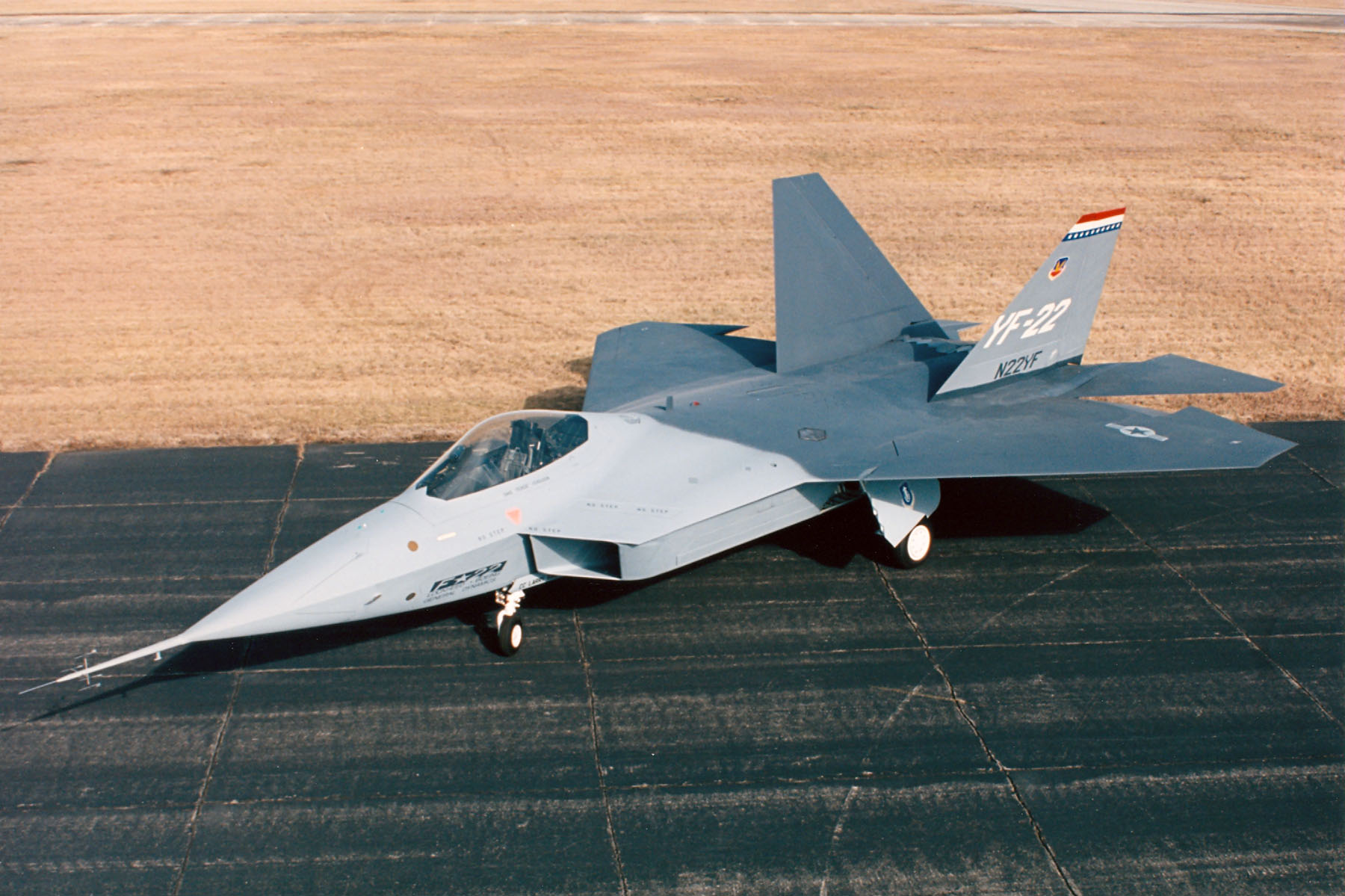
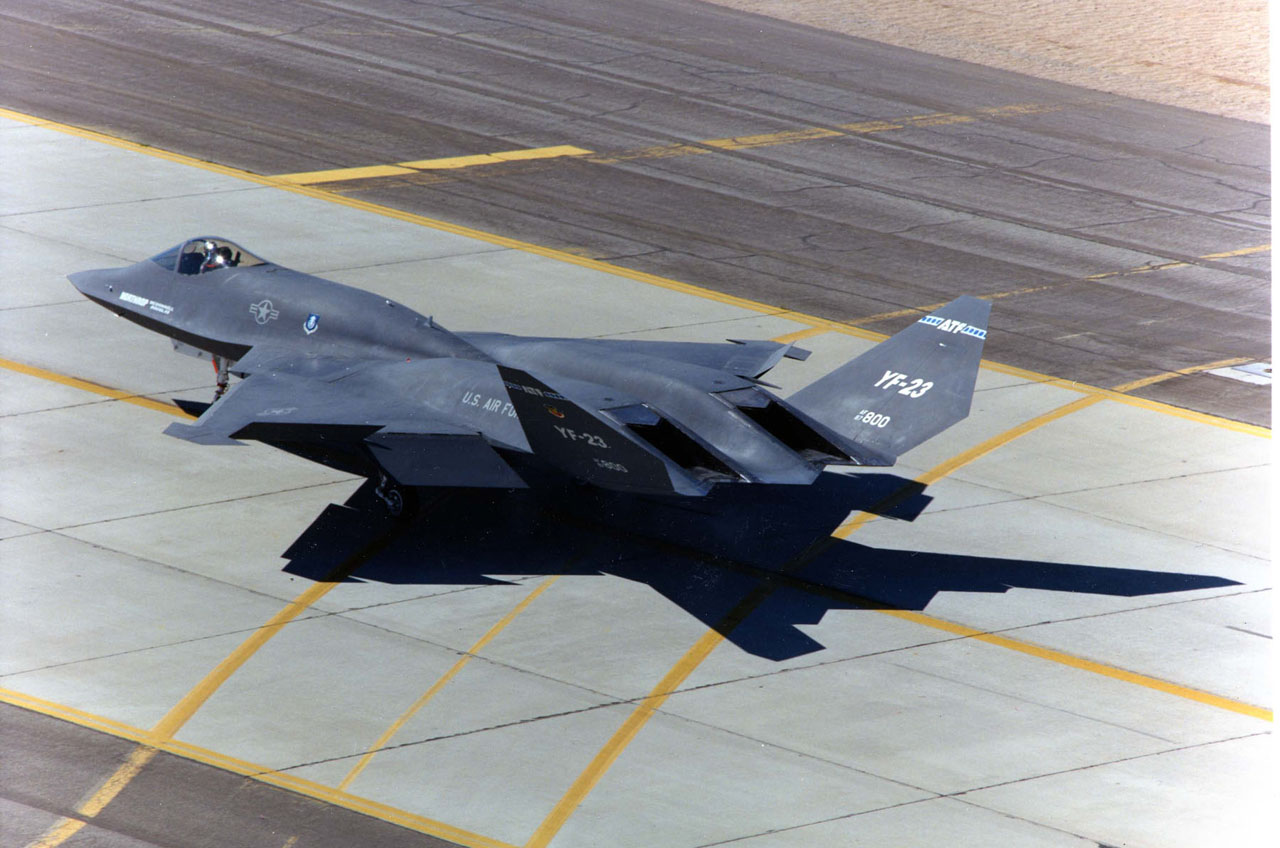
The current F-22 looks and acts nothing like the YF-22 that won the competition (despite the YF-23 being much better, but that's another story).
The fact that the B-52 production was not just similar to the prototype, but similar to a complete mockup is a testament to the accuracy of their initial vision. The fact that the US continues to use that design after so many decades is even more amazing.
The YF-23 was better in some ways, worse in others. Compared to the YF-22 it was faster, longer ranged, and (probably) more stealthy. But it had a smaller weapons bay and was less maneuverable. Both aircraft met the ATF program technical requirements. The final selection was based primarily on the Air Force having greater confidence in Lockheed over Northrop in being able to run the program on schedule and budget. The notional production F-23 would have been quite different from the prototype.
> The final selection was based primarily on the Air Force having greater confidence in Lockheed over Northrop in being able to run the program on schedule and budget
Unexpected. The Lockheed YF-23[1] looks like it would fall apart if you breathed on it wrong, while the Northrop YF-23 is such a slick design it looks like it's moving while standing still.
Well the Lockheed YF-22 prototypes didn't fall apart through an extensive flight test program including multiple supersonic flights and weapon launches.
I thought the YF-23 had a larger weapon bay, but there was some debate at the time about the design of the delivery mechanism. On the flip side, having one, large bay allows for weapons configurations that aren't possible with multiple, shallow bays.
Maneuverability in a stealth plane is not of much use. Just like the F-35, the goal of the YF-23 was to use its vastly superior stealth capabilities take out the enemies before a dogfight happened. Given that drones can take G's that will turn a human's brain to mush, this is a much more sensible strategy in modern combat and renders the F-22 vectored thrusters as mostly an expensive and useless feature that sacrifices the much more important stealth of the YF-23's hidden engines.
I believe the claims of being worried about timetables were just making up excuses to choose a worse plane. The F-22 was 100% redesigned anyway (making a "competition" nothing but a formality). It was delivered years late and WAY over budget.
YF-23 had faster supercruise, a much bigger range, and had a way larger internal ordinance bay (external ordinance kills stealth). They intentionally skipped the sexy vectored thrusters for B-2 style inset exhausts which make infrared signature much smaller (especially to ground-based attackers). This meant the YF-23 could have delivered more ordinance faster and farther while having higher rates of mission success due to better stealth.
F-22 won the competition on two and a half points.
First and foremost, the YF-23 was going to be built in 10-11 states while the YF-22 was going to be built in almost 30 states, so something like 40 senators had their state's financial interests at stake with the jobs this would bring in (though nobody involved would ever openly admit this was one of the big reasons). Of course, spreading stuff out increases all kinds of costs and with so many small places, once the main run of planes was done, all these sub-contractors moved on too. As a result, the US can't get all the F-22 parts they need and the F-22 is going to be scrapped way before what would otherwise be necessary.
Second, is that the F-22 had vectored thrusters, so was theoretically more maneuverable. This is somewhat debated because making a YF-23 variant with vectored thrusters was possible and even without it was more than capable of turning a pilot's brains to mush (by far the biggest limiting factor for any manned fighter). Ironically, the big selling point of the F-35 is to be so stealthy that you can kill targets before they can see you due to stealth without the need to dogfight which was the exact YF-23 strategy too (and of course, vectored thrust seems to be a needless and cost-adding addition to the F-22 as the strategy for them is also to engage at ranges where maneuvering isn't a critical task). In every other category of consideration, the YF-23 was far ahead of requirements while the YF-22 was barely satisfactory.
The half point is the stated delivery concerns. The Air Force claimed they were worried that the planes wouldn't be delivered because the B-2 was already behind schedule. As EVERY plane is ALWAYS delivered behind schedule, this is very dumb reasoning. While the YF-23 team had worked for years to make a ready-to-ship plane in the YF-23, the YF-22 was a cobbled-together mess to the point that the entire airframe was redesigned multiple times. As a result of this and that spread-out construction crew, the F-22 was way behind schedule and way overbudget.
Northrop Grumman allegedly asked about using YF-23 designs in a bid for the next-gen Japanese fighter project, so maybe there's hope for it yet (I'd note that the profile of the Russian SU-57 has a strikingly similar look).
EDIT: As to the B-52, the real issue is that making a new plane would give marginal benefits to the airframe while the retraining and costs would be large (not to mention the usual teething problems of a new design). This is similar to how they tried so many times to replace the m4. Better systems exist, but they weren't worth the upgrade (lots of people suspect that their new rifle will be too heavy for most soldiers too).
The most profitable upgrades to the B-52 are the internals and electronics and this has been done several times.
The second best upgrade is more modern and efficient engines, but this has been a very slow to happen. They've announced plans to do this, but I suspect it will be longer than they think. They are claiming reduced maintenance time and a 30% increase in efficiency. Not a bad upgrade, but also not that huge when you consider that's basically 0.5% for each year since it was first designed.
> While the YF-23 team had worked for years to make a ready-to-ship plane in the YF-23, the YF-22 was a cobbled-together mess to the point that the entire airframe was redesigned multiple times.
The YF-23 team had to turn in their specs in the competition and you wonder if the referee was partial to the YF-22 team and gave them opposition research. That was the feeling I got from interviews & documentary.
Boeing already had experience and credibility with the USAF from the earlier B-47. In some respects, the B-52 is “the B-47 but bigger”. You can see it in the similar fighter canopy cockpit on the XB-52.
Conceptualized, but also pondered upon, and considered worthy of further effort. A conceptualization can be done as fast as a single second, but it can take ages to weigh it against alternatives.
You can apply the "conceptualization" criterion retroactively to any successful project. They all started as an idea that someone noodled around with for long enough to decide to pursue it further. You can draw the line where that initial noodling ended and serious work began pretty much anywhere you like.
Heh, exactly. Succinctly put. Here's a longer-winded version: I'm an R&D Software Engineer. In a workplace setting years ago we had a Software Architect who would advise management and the implementation engineers. Me and my team were really struggling with a difficult implementation problem relating to some federated identity stuff. Management told us to go to the architect. We explained our problems and he waved them off as "that's implementation stuff, I don't do that, but the solution is very easy. Just get server X to communicate whatever token you need to server Y". It was off putting. He also told our management that our problem was an "easy one", without offering any helpful insight.
It's like saying "Traveling to The Moon is easy. You simply need enough thrust to overcome Earth's gravity well. Simple!"
I always tell people that I could probably "architect" the infrastructure of my whole company (Fortune 500) in a few days if you ignored the little pesky implementation details.
Meh, the Archos Jukebox was doing that well before Steve Jobs. Steve's genius concept was "I want all my music to fit in the palm of my hand, but with a way better UI than Archos Jukebox"
As an owner of an Archos Jukebox, the differences went way beyond the software interface.
The Archos was way larger and heavier than the iPod, and the build quality was abysmal. Mine essentially fell apart despite seeing only desktop use. Battery life was inferior as well. Headphone output was also much louder and cleaner on the iPod.
Literally everything about the iPod was better than literally everything about the Archos.
Yes, but the 1.8” drive in the iPod was a true differentiator. It was the difference between “in the palm of my hand” and “it is possible to hold it, but not easy.”
The iPod also fitted easier in the typical hand (and, probably more important, in the typical pocket). Dimensions of that Archos: 3.1 in x 4.4 in x 1.2 in = 16.4 in³
Dimensions of the first iPod: 4.02 in x 2.43 in x 0.78 in = 7.62 in³. That’s less than half the volume.
(Weight-wise, the difference is smaller (10.2 vs 6.5 oz)
It's honestly a fantastic case for incremental improvements over time. There's practically no single part on a modern B-52 that's original to the 1960s since everything has been overhauled and modernized decade by decade. Every attempt to replace it has been (or will be) retired before its EOL.
> Every attempt to replace it has been (or will be) retired before its EOL.
Though that's probably because it's design is basically "big, boxy, utilitarian sky truck," which is so flexible you can always find something to use it for. Everything else seems to make tradeoffs for some flashy capability, which don't age as well.
How long have the B-52 jet engines had monocrystalline fan blades? That must have an enormous impact on efficiency and performance. They became available in the late 60s.
They're still using the original TF33 engine they were delivered with in 1961. Presumably the fan blades have been replaced many times over during maintenance, but I don't know if there's any advantage to switching to better blades if you don't change the operating parameters to take advantage of them.
There's a plan to replace all the engines with a modern turbofan (RR F130).
It's interesting that even though the bypass ratio changed from 1.4 to 4.2 (so it's quite a different engine, lot quieter for sure) the fuel consumption only went down 15% (22g/kN.s to 18.6g/kN.s)
Hmm, I'm not familiar enough with jet engines to say whether that is expected or not. 15% doesn't sound like a huge improvement, I agree.
But I'll note the F130 is a medium bypass business jet engine producing 'only' around 75kN. 8 of those is about 600kN, which could be achieved with two of those newest generation civilian high bypass turbofans used e.g. in the B787 or A350. I suspect the motivation was to choose a new engine that is as similar to the existing one in order to minimize work needed to install them on the plane. There being AFAIU less than 100 B52's in service, I guess minimizing engineering cost has better payoff than minimizing fuel consumption with a high bypass engine.
These engines are also way larger diameter => redesign nacelles => higher drag and moment => engine mounts + wings ...
Also this family of engines (F130/BR700) has insane reliability - something like one unplanned engine removal per 100,000 hours. Some have reached 1 million hours
Doubling the thrust is likely overall a bad idea, for the reasons you mention.
Also looking at other posts in this discussion, it seems the 4-engine option (4x 150kN class size engines to provide about same overall thrust) was discarded because the asymmetrical thrust in case an engine gives out at a critical moment (takeoff, say) would mean that the plane would need a bigger tail in order to have enough rudder authority. Which in turn would mean that the airframe would need strengthening to take the added weight and stress from that bigger rudder. Etc. etc. leading to the cost of the engine replacement program spiraling out of control. So in that sense as close to a 1:1 as possible is the right decision.
The plan in the 90s was to use 4 high bypass engines and replace the tail. At the time improving the -52 was not favored by the USAF because it would threaten the B-1. I still think it is the correct approach
Of great importance was not rewiring or modifying all the engine controls: the new engines had to slide right in and attach to the controls the old engines used. This alone demanded 8 small engines. Read about how they solved the flutter problem on the 747 and you’ll appreciate how important it is not to change the aerodynamics of the wing in any way. Finally, competition for the contract was fierce as there were many different engines that approximately fit the profile: it was very close to competing business jet designs with successful production histories. Rolls Royce, I think, was a surprise winner.
Turbine blades, not fan blades. The single crystal metallurgy is to avoid high-temperature creep (i.e. slow deformation over time under an applied load), which is a life-limiting factor in turbine blades. Especially the first row or two which see the highest temperatures.
At least in civilian aviation, it is a very relevant and practical question, and a major contributor to the Boeing 737-MAX fiasco.
There is a thing called "type rating", that is qualification pilots need to have in order to fly a specific type of plane. For example, pilots need a type rating for the Boeing 737 in order to fly a Boeing 737.
Manufacturers try to do everything they can not to require another type rating when they make changes to an existing aircraft, because type ratings require expensive and time-consuming training that pilots and their companies would rather avoid, and it influences purchase decisions. One of the root causes of the B737-MAX crashes is that Boeing tweaked some settings in order to make the B737-MAX behave like the original B737 when it was, in fact, a different plane, and they did it wrong.
> One of the root causes of the B737-MAX crashes is that Boeing tweaked some settings in order to make the B737-MAX behave like the original B737 when it was, in fact, a different plane, and they did it wrong.
This is wildly wrong. The only thing you got right is that the MAX was designed to avoid needing a new type certification.
Boeing radically shifted the Cg to accommodate changing trends in the commercial airline industry which were resulting in Airbus's planes being more competitive. They shifted it well outside what would be considered prudent.
This required flight control software bandaids to keep the plane stable (or perhaps better put, from entering a flight envelope where loss of control would happen), but they then also cheaped out of providing redundancy for some critical sensors... AND cockpit annunciators to alert on failures of the sensors.
Boeing then passed off the Cg shift and additional systems as very minor changes in the filing for their airworthiness certifications, the FAA rubber-stamped everything because they didn't have the staff to review all these certificate filings so they largely trust manufacturers...
...and then making things even worse, Boeing did very little to disclose the additional stability system and sensors to the airline's chief pilots who develop the in-house training. To say they were furious to learn they hadn't been told of the new systems would be an understatement.
The MAX crashes would have been substantially less likely if the pilots had benefitted from their airline's chief pilots knowing of the safety systems and having training on how to handle failurs, as well as warning annunciators for sensor failures....but Boeing wanted to save a thousand bucks or so per plane - or more likely, wanted to avoid drawing attention to the situation and having people ask "why is a critical flight control system dependent upon a single sensor?", which is likely why they also did little to inform airlines of the new systems, train the chief pilots on it, etc.
I generally agree with you, except for the fact that it was more of an aerodynamic issue than a center of gravity issue: the large body of the engine produced lift at higher angles of attack, making the nose go up and worsening the problem. The fact the engine was more powerful also contributed to that problem: the higher thrust produced more upwards torque.
And I am not saying that the software bandaid and the goal of avoiding a new type certification is a bad thing. In fact, it is done all the time with no ill effect.
What I am saying is that they did it wrong, and that's the real problem. Your explanation on what they did wrong is, I think, entirely correct.
My hypothesis is that if they didn't care about keeping the same type rating, they probably could have skipped the bandaid and trained pilots to just keep out of that dangerous configuration, just like pilots are trained to recognize, avoid and recover from stalls. It didn't look like an unmanageable problem for pilots, more like something they needed to be aware of and train for.
The earlier models were manufactured in the 1950s.
Most of the H models were manufactured in 1960 and 1961, but they have undergone significant airframe improvements, several engine improvements, and of course, avionics improvements.
It's still a B-52, but it's a "B-52H Block $whatever_design_block_they_are_on_these_days" model.
Yes, it is. The current H generation has very little to do with the first build airframes so. Including certification.
EDIT: Those upgrade programs, e.g. the F-15 is currently at "X", are complete development programs and involve a certain amount of certification and re-certification. That in the case of the B-52 those upgrades have been applied to existing, tremendously old, airframes, doesn't change that. It does make it quite impressive so, the B-52 turned out to be a very flexible and upgradeable design.
That's a little disingenuous, regarding the F-15 -- there is the A/B series, with A being single-seat and B being the two-seat trainer, and the C/D series, with the same distinction between the two models. Both the F-15A and the F-15C are air superiority fighters, with an exclusively air-to-air role. The F-15E is a multirole fighter-bomber, not an air superiority fighter. The F-15X is an F-15E repurposed as a beyond visual range (BVR) missile truck, with data links to AEWC planes that can provide targeting solutions for those missiles. All of the letters between E and X have not been used.
Wonder what a from-scratch B-52 equivalent would look like nowadays. I don't think they could resist the urge to give it a gimmick. Who wants to design a bomb truck?!?
But, while stealth is really useful, it does require some trade-offs. Since B-52 is only useful in cases where stealth isn't required, and it seems to still be in use, I guess if the B-52 were hypothetically retired there'd be room for a non-stealth replacement. Unless the techniques they developed to come up with the F-22 and F-35 opened up a possibility of a zero-compromise stealth design (I'm skeptical, but I don't know anything about plane development).
> The first prototype of the B-52 may have been designed in a weekend.
Not even that is true. Here's the timeline from the article.
> In July of 1948, Boeing received a contract from the still-new U.S. Air Force to design and build a new heavy bomber.
...
> So when Boeing’s three-man presentation team arrived at Wright Field Air Force Base on October 21, 1948
...
> Warden suggested to the Boeing team that they do away with their design and come back to him with a new one that included turbojet engines ... unbeknownst to Warden at the time, Schairer happened to be carrying some work he’d already done on the possibility of a jet-powered bomber in his briefcase, giving him just enough of a foundation to think a redesign might be possible
...
>The next morning, which happened to be a Friday, the Boeing team returned with their newly jet-powered B-52 design, only to find that Warden remained unimpressed.
...
> The two soon joined Schairer, Wells, Carlsen, and Blumenthal in the increasingly cramped hotel room, pouring over sketches and quickly-scribbled mathematical computations. Computers wouldn’t become a common facet of aviation design for decades to come. It was up to these six men and their witts to design an entirely new bomber… and they had just 48 hours to do it.
..
> By Sunday, the team had compiled a full proposal that they turned over to a local stenographer to type up a clean copy. By Monday morning, they arrived back in Warden’s office with not only a fully-realized 33-page B-52 proposal but a silver, hand-crafted, 14-inch model of the bomber itself. Warden immediately took to the weekend design.
So, July -> October 26th (Monday morning)
4 Months isn't bad at all but it's not quite the 4 days suggested in the headline.
> The B-52 of today was iteratively designed over decades and the current H models are entirely different planes than earlier models (although structurally very close to the G model).
The plane was only ever produced for a decade and the H model was last produced in 1963.
Obviously it has been retrofitted with new engines, avionics, armaments, etc, but it's not a fundamentally different plane.
I don't think that's unusual at all for any jet aircraft that's around for decades. They almost all get new engines, avionics, etc. That the B-52 still has 8 engines is somewhat surprising...that's not terribly desirable.
The Air Force considered replacing the 8 engines with 4 more powerful ones. However, they determined that the loss of one of those engines on take-off would cause a dangerous thrust asymmetry. Dealing with that would have required more extensive changes like moving the engine mounts, so they dropped the idea. But they are going to replace the engines with newer models.
I had seen/heard/read that the thrust asymmetry was a design feature to help with yaw, and that fewer engines would overpower the design limits of other parts of the airplane, to the extent that everything else would need to be redesigned to handle them (mounts, tail, rudder, etc.)
You can use thrust asymmetry to help with yaw, yes.
But here we're talking about unplanned sudden thrust asymmetry, causing a massive yaw force at a critical phase of flight, takeoff, where you're engines are likely to be near their full power and you're close to/on the ground.
If you go from 8 engines to 4, loosing one engine goes from causing 25% thrust loss on the wing to 50%.
What if most major structural elements of the plane, the skin, the control surfaces, etc. are ~1960 original? Multiple rounds of upgrading avionics, weapons, engines, etc. are extremely common in military planes.
I’ve not read too much on the Soviet space program, but whenever I read about Buran (a wonderful accomplishment per se) my thought process goes something like this: “The Soviets must have seen the Americans working on the shuttle thing -> the Soviets must have thought that that shuttle thing was great mostly on account of the Americans working on it -> the Soviets built a shuttle system for themselves -> the Soviets threw away lots of resources for almost nothing”.
Also, as it became apparent in the meantime, even the Americans didn’t get it right when it came to the reasons behind building the shuttle system. As far as I understood there were other, less expensive ways, that they could have taken in order to “improve” their space program.
Buran system was very, very different from US' STS, and honestly multiple groups combined under one umbrella to get what they wanted in Buran project. Some bits of Buran were a "me too" (the visual look of the orbiter, for political reasons), but Soviet space program has combined multiple previous tracks that existed independent of what Americans were doing.
Among various tracks that combined together, there was
1. Super Heavy Launcher - a long term dream since the failure of N1, realised in Energia
2. Reusable crewed orbiter - Buran orbiter
3. Mir-2, the successor to Mir space station - was supposed to use (1) for construction and (2) for crew
4. Fully reusable launch vehicle - was proposed continuation of Energia project
5. various missions requiring super heavy launchers (either Energia, or prospective Vulkan which added extra energia core stage on top) - including mars missions that were on slow boil since end of moon program
6. Soviet Space Forces - anti-SDI systems, orbital warfare unmanned cruisers (Polyot) etc. - dependant on (1).
7. Reduction of space construction and launch costs - nuclear-powered orbital tug launched by Energia which would be responsible for moving objects from low LEO to target orbit, including GEO
1,2,4, and 7 were all included directly in the scope of Buran, with Polyot (6) being in progress as well (the other Energia launch was launch of Polyot test unit).
Note that Buran orbiter, the one part that resembled Shuttle, is independent of other tasks though considered beneficial for the space station goals - if the orbiter project failed, it would still provide data for Reusable Energia variant, and Energia would still mean a working 100t-to-LEO system they could use for whatever - unlike Shuttle which was one specific vehicle. This also meant that Buran's orbiter had much lower cargo capacity - because it didn't need to have higher one as space station modules and the like could just use Energia.
How does one separate the outer mold line of the spacecraft from its performance?
Isn't Buran's appearance driven by similar requirements vs. aesthetics? What else would it have looked like — if you want lots of crossrange capability, you're not going to get something that looked like Faget's designs, would you?
Buran had different design requirements (once you discard the political), because unlike STS the orbiter wasn't sole launcher of the system - Energia took care of shipping heavy cargo to whatever orbit you wanted. So they had different set of constraints including size & prospective contents of the cargo bay.
They have also flirted with the idea of just putting two jet engines into orbiter for extra cross range, which was probably not an option on STS given the huge dead weight of engines
It wasn't needed because the STS wing area achieved the goal of not overflying the Soviets after dropping off a military satellite (once-around mission out of Vandenberg SLC-6), and the US had many politically friendly potential landing areas, while USSR did not.
Catering to NRO and USAF wartime requirements doomed the STS to cost overruns. Sticking with Faget's designs and the NASA requirements may have salvaged the program's cost goals, but I'm no expert.
I didn't miss the /s, but I feared others might think different ;)
From what I've read, the decisions to make Buran look externally like STS orbiter was a political one, and the engineers at MiG OKB weren't happy about it - they have been working on a bunch of space planes for some time, including the infamous suborbital fighter. However the similarity was found to have political benefits in the weird opposite of kremlinology and the decision stood.
Not having USAF's annoying requirements though, they were able to design a better system anyway. (Pre-USAF involvement STS was also better, but congress cost cutting made a necessity of begging DoD for funds)
Essentially, the Buran orbiter had different function, and thus different forces on its form.
US' STS shape was ultimately dictated by its cross range requirements combined with cargo capacity. Explicit case of function leading to specific form.
Buran didn't require the same huge cargo capacity in the orbiter, because Soviets had already tested and verified self-assembly of space station in orbit from multiple launched modules (technology that they would later employ in ISS). For huge capacity it had Energia, which once proven could be also launched on Polar orbits (the specific requirements from USAF for STS involved heavy cargo on polar orbits from Vandenberg).
This meant that Buran orbiter had wider design space to explore, and previous experiments in crewed reusable spacecraft were centered around lifting body shape, to extent much higher than STS was. However, the command to make it look like US STS came pretty early in the project, in addition to general lack of documents, so we don't really know how they would go.
I wish I was more diligent in noting back then, but essentially I went on a long walk on google, encyclopedia astronautica, checking russian pages with google translate etc. trying to read as much about the project - at the time it was still running we had more information published in Poland about Shuttle (including accurate drawings and system descriptions) than about Buran, and thus I was always left fascinated about this space plane that, compared to STS, I had only a blurry photo and maybe A4 page of description.
> 27. Alternative projects considered at the stages of the preliminary design and preliminary design: attempts to create OK "Buran" on the basis of OK "Spiral" - what was proposed (options and technical solutions) and what was accepted, what was not accepted, how and why.
> Orbital vehicle "Buran" in landing configuration
> Answer: We (NPO Molniya) worked on an alternative variant in a guise that mimics that of the Spiral orbital plane, but General Designer Glushko considered that by that time there were few materials that would confirm and guarantee success at a time when Shuttle flights proved that the Shuttle-like configuration works successfully and there is less risk when choosing a configuration, therefore, despite the larger useful volume of the Spiral configuration, it was decided to carry out the Buran in a configuration similar to the Shuttle configuration. Although the absence of sustainer engines on the Buran noticeably changed the centering, the position of the wings, the configuration of the influx, and a number of other differences.
> 28. Was the copying of "Space Shuttle" in a larger or smaller volume during the creation of Buran deliberate or were there "directive instructions"?
> Answer: Copying, as indicated in the previous answer, was, of course, completely conscious and justified in the process of those design developments that were carried out and during which, as already indicated above, many changes were made to both the configuration and the design. The main political requirement was to ensure that the dimensions of the payload compartment were the same as the payload compartment of the Shuttle.
> Shuttle flights proved that the Shuttle-like configuration works successfully and there is less risk when choosing a configuration
Classic Soviet risk-averse behavior. See also: copying every single detail from the B-29 because they knew it worked and it would be their heads (perhaps literally) if the Tu-4 didn't. They did the same thing with Joe-1, their first atomic bomb test. Do what you know works so you can go home at the end of the day. Innovation is a luxury.
This is what happens when employees fear management. Lessons to be learned.
I guess I was wrong on that part. Interesting that Spiral had greater capacity, I thought the opposite based in some of the sketches - possibly I mixed up sketches of another MiG space plane.
Wish someone manages to one day do a definitive history translated into English
It's worth noting that the C-130 Hercules has been in continuous service since 1956, and new aircraft were still being produced at least as recently as 2015 (and perhaps longer). That aircraft really is a flying truck!
> Claiming that something was designed in a day is good clickbait
It also glorifies an attitude that the greenfield design process is where the wizardry happens, and that forgetting about or dropping products after this stage is acceptable. Only failed products don't need to be maintained and refined.
The OP is emblematic of the "cocktail-party level of understanding" that leads people to discount how hard it is, and how much blood, sweat, and tears it takes, to build anything complicated, like a plane: https://danluu.com/cocktail-ideas/
It also downplays the absolute skill you need to be able to do even the “weekend session” and get something that’s workable - anyone can doodle a design in a weekend and even make changes to it, but getting one that’s actually a workable foundation requires people who know what they’re doing.
I don’t know. Seems like apocrypha layered on apocrypha go me
>…I wrote FAT on an airplane, for heaven’s sake.”
>(I can’t believe I had to write this: This is a dramatization, not a courtroom transcript.)
>This “I wrote FAT on an airplane” line was apparently one Bill used when he wanted to complain that what other people was doing wasn’t Real Programming. But this time, the development manager decided she’d had enough.
>“Fine, Bill. We’ll set you up with a machine fully enlisted in the Windows source code, and you can help us out with some of your programming magic, why don’t you.”
Kind of, but the source here is someone who has been at Microsoft a very long time. Given that he didn’t put any qualifier around this story about it possibly not being true, I think it’s more likely that it is true. If this were J Random Blogger I’d agree with you.
I don't see anything wrong or less deserving of merit in designing something remarkable in a short time.
How much does it take to have a life-changing insight? or the moment of solving a challenge to resolve a theorem demonstration? An instant or your whole life up to that point?
Seems like a language thing—I'd distinguish the initial "design" from the iterative "engineering". Of course, you could describe the latter as design, too, but it's an ambiguous word (like most words). The people taken by this clickbait aren't going to care which word is used.
Also, the people designing these things have years of experience and are most likely thinking about these designs daily through out the years. So, in reality it's 100s of years of synthesized experience to be able to design something over a weekend.
> Another HN commenter mentioned GPS being designed over a holiday. But we spent years and years in the military debugging GPS and making it functional.
The B-52 design proposal was done in a hotel room over one weekend, the actual engineering took at least 3 years, including "670 days in the wind tunnel". That is not to say the weekend hotel proposal was not an impressive accomplishment in itself, it was. But there's a difference between laying out a software architecture and writing code.
> On Thursday, 21 October 1948, Boeing engineers George S. Schairer, Art Carlsen, and Vaughn Blumenthal presented the design of a four-engine turboprop bomber to the chief of bomber development, Colonel Pete Warden. Warden was disappointed by the projected aircraft and asked if the Boeing team could come up with a proposal for a four-engine turbojet bomber [...] By late Friday night, they had laid out what was essentially a new airplane.
> [...] On Monday, Schairer presented Colonel Warden with a neatly bound 33-page proposal and a 14-inch (36 cm) scale model. The aircraft was projected to exceed all design specifications.
> [...] During ground testing on 29 November 1951, the XB-52's pneumatic system failed during a full-pressure test; the resulting explosion severely damaged the trailing edge of the wing, necessitating considerable repairs. [...] The XB-52 followed on 2 October 1952. The thorough development, including 670 days in the wind tunnel and 130 days of aerodynamic and aeroelastic testing, paid off with smooth flight testing. Encouraged, the USAF increased its order to 282 B-52s.
I feel it is fair to say that in many ways, the "architecture" of the B-52 was pioneered in Boeing's B-47 (first flight 17 December 1947 - seven months before these meetings.) This was a truly innovative aircraft, unlike many other contemporary designs (from Boeing as well as other manufacturers) which resembled their piston-engined precursors. The initial Boeing proposals for the B-52 look like throwbacks to that approach.
The article briefly mentions that Bob Withington, one of the members of this ad-hoc proposal-redesign team, played a role in the swept-wing design of the B-47, but is otherwise silent on its significance.
Yes. The B-47 was sort of a scaled-up jet-fighter. Look at the cockpit layout.[1] It outperformed some fighters of the era. The original B-52 proposal looks like a modified B-36. The B-36 was the first intercontinental bomber, with "6 turning and 4 burning" - 6 props running on piston engines, plus four jets. That early B-52 proposal looks like something based on the B-36.[2] A bigger B-36 would probably have worked, but it would have been a dead end.
Both the B-36 and the B-47 were difficult aircraft to fly and maintain. The B-36, with all those piston engines, was a headache. Too much powerplant to maintain, and underpowered by jet standards. The B-47 needed a rocket assisted takeoff booster to get off the ground with a reasonable amount of runway, and operated too close to the "coffin corner", with cruising speed and altitude too close to stall. Over 2000 were built, over 200 crashed, and none remain flyable. With the B-52, the USAF got an intercontinental bomber that flew well, could be maintained, and had enough power to get itself off the ground without rocket boosters.
Its successors were less useful in actual conflicts. Too short ranged, too expensive, less bomb load, etc.
Coincidentally, I was watching a YouTube video last night about the YB-60. This was a version of the B-36 with the same jet engines as the B-52. And the aircraft lost in a competition with the B-52 because the Boeing jet was just plain better than the Convair jet.
Boeing did a very good job. I don't think there have been (or will be) another aircraft that lasted this long in service. There are prettier aircraft (in my opinion), but "pretty" doesn't get the job done. The Big Ugly Fat Fella will be around for quite some time.
My uncle (Army aviator) retired some years ago as a chief warrant officer with a ton of hours in Hueys, starting with a couple tours in Vietnam. He likes to say that the flight crew from the last B-52 landed at Davis-Monthan will be flown back to their cars in a UH-1. He might be right.
Relating his time in the aircraft in VN, he said there was little to compare with skimming the rice paddies with the doors removed, periodically going up a bit to clear water buffalo, carrying a load of beer for the guys in a firebase. He mostly flew medevac slicks in combat. Gotta save those boys.
In this context, "design" means working out the key parameters of the airplane: takeoff weight, length, wing span, wing sweep, engine thrust, etc. Even today aerospace engineers learn how to do this first cut analysis using various approximations and rules of thumb. Still impressive, especially before computers, but the article isn't referring to a build-ready blueprint.
Supremely entertaining and just totally wild. It is written by the engineer that led F-117 Nighhawk program, "What do you mean it appears the size of a bee on the radar?"
As they say, if it doesn't make you question the metrology, it isn't a breakthrough. They thought the radar was faulty.
Some of the most successful programs are designed either by one person or a small group of designers who were given the autonomy to do their job. This story reminds me of the origin story of the American GPS system which was designed over a holiday weekend by three engineers. If you want projects to work then give a small, qualified group the room to make decisions and turn them loose. If you want to give the appearance of doing something for years on end then assemble endless committees and design reviews (like the F-35, Ford Class carrier, DDX-21, etc).
More like the initial design concept was defined over a weekend. The actual detailed design, even for highly successful programs like the F-117, took much longer. Nobody ever designed an aircraft for serial production over a weekend, not even back when planes were build out of canvas and wood.
EDIT: After reading the article, what Boeing did back then was the same thing as Boom coming up with a rendering and a high level design concept over the weekend. Also, back then times, and technology, were different.
I think the point being made is that many projects start as an idea that is then brought into the prototype phase, iterated upon, and then is complete whenever the project delivers a significant increase in current capabilities compared to the current systems.
This in contrast to the F-35 project which apparently decided all the capabilities up front and then has went about designing an aircraft to somehow reach all those goals. Whether or not it will is a subject of ongoing debate. It also somehow has wound up making 3 different airframes.
A good example of this would be Soviet copies of the B-29 & the V-2. In both cases there was pressure to "build our own that is better". Apparently Stalin got involved in both cases and demanded that a way be found to produce a domestic copy first, then learn from that, & produce a domestic design next. Not sure how accurate that is, but it seems to have worked out. Soviet long range bombers & Soviet missile systems are certainly nothing to scoff at.
Reducing the number of engineers wouldn't have made the JSF, CVN-21, or DD-21 programs more successful. The designs largely met the customer requirements, and any technical failings were within normal expectations for innovative programs. The problems were more due to flawed customer requirements, funding limitations, and political decisions to move prematurely into production without adequate testing. For example, the DD-21 was primarily intended to provide naval gunfire support for amphibious assaults but it turns out that's no longer really needed at all.
This discussion reminds me of the USS Hornet aircraft carrier museum in Alameda (near Oakland). It took 54 weeks to design, build and deloy it. It's a museum now; highly recommended. They have some Apollo stuff too.
Four years from concept to first flight for the B-52 is impressive. The "over one weekend" claim (which the body of the article refutes) is annoying.
To be fair, the Hornet was the fourth Essex class carrier, so much of the design work was already done by the time the Hornet was launched (just a couple of months after the Essex and her two "older" sister ships). Commonality of design was what helped build and launch these wartime ships so quickly.
To anyone who's wondering how is such a feat possible: it's covered in the first few chapters of Dan Raymer's Aircraft Design.
Reading it made me appreciate (again) the "old" way of knowledge sharing- books and publications. I'm amazed that it's so under-appreciated tool nowadays.
There is an obvious downside to how cheap it is nowadays to "publish" something, whether on social media, in a blog or in something resembling a book, we are now surrounded by low-quality content and it can be hard to tell the good from the bad.
Another benefit of books and magazines is that you have an instant idea of how relevant the information is, "Electronics Weekly 1970", possibly not the latest best advice on using microcontrollers!
On one hand this implies that the B-52 has been useful all this time-- and to some extent it has in different roles. But on the other hand, when the U-2 was shot down in 1960 it could never perform the role it was designed for. Since then the Air Force has sought different planes to fill that role and different roles for the B-52.
In that sense B-52 is like the battleship designs of WW1 that fought in WW2 and onward. Not sticking around because they are so effective but instead sticking around because they are dead ends.
…and I designed a viable personal flight device that with modern 3d printing (hollow like bird bones) techniques and really upgraded power (LiPo and beyond) and posted it on Medium a couple years ago…and people are still talking about VTOL stuff. Eww.
Granted, I probably need to design a catapult to get it up to speed without big battery drain…but there are really great innovations yet to even make it to prototype IMHO.
Language isn't static, it never has been, yet as soon as the notion of spell checking came about, written forms of words started to be frozen in time. If "tomorrow" is a valid rendering of "(on) t(he) morrow", I don't see why bonified is an issue.
Nobody's saying language doesn't change, but that's not an all-purpose excuse. If people notice your mistake, and it changes their understanding of what you're trying to communicate — including making them doubt your knowledge — then it's a mistake, and not an updated usage.
They thought about it but decided it would be a waste of money. Lots of considerations go into engine choice and making changes is quite expensive.
>In 1996, Rolls-Royce and Boeing jointly proposed fitting each B-52 with four leased Rolls-Royce RB211-535 engines. This would have involved replacing the eight Pratt & Whitney TF33 engines (total thrust 136,000 lbf (600 kN)) with four RB211 engines (total thrust 148,000 lbf (660 kN)), which would increase range and reduce fuel consumption, at a cost of approximately US$2.56 billion for the whole fleet. However, a USAF analysis in 1997 concluded that Boeing's estimated savings of US$4.7 billion would not be realized and that re-engining would instead cost US$1.3 billion more than keeping the existing engines, citing significant up-front procurement and re-tooling expenditure.
Because the rudder on the B-52 is too small to maintain lateral directional control with an inoperative outboard engine in a 4-engine configuration at takeoff power/airspeed. Go google for some pictures, on a B-52 it is less than 10% of the span of the vertical stabilizer, compared to more than 25% on a 747.
And if the rudder were made large enough to maintain directional control, the loads in the aft fuselage would be large enough that the aft fuselage would need to be re-designed.
Someone else mentioned in another thread that it's for resiliency. I guess if you're carrying 70,000 lbs of ordnance you don't want an engine failure messing with your thrust too much during critical flight phases.
Out of the loop, exactly why does the USAF still fly this?
Is it really a better alternative to putting some bomb bay doors on a modern Boeing?
Without dismissing the entire field of aircraft design... the mind is definitely attracted to the concept of buzzsawing some doors onto the bottom of civilian airliner.
I think a lot of it has to do with the challenges of validating changes to aircraft as safe. Additionally, the B-52 is relatively simple and inexpensive to operate.
As a lay person I imagine that the high wing of a B-52 vs the low wing of a modern Boeing might have something to do with center of gravity given the relative density and dynamic weight changes of bombs during a sortie vs stable passengers and luggage on a flight.
Since aircraft operate at much higher speeds than what we normal humans are accustomed to on a daily basis, there are significant concerns having to do with things like vibration [0] that may not be obvious.
That isn't to say that people aren't trying to reuse more commodity hardware over bespoke. For example, I understand that the P-8 Poseidon [1] is considered a successful program. It uses the 737 frame and does launch munitions, albeit not as many as a dedicated bomber aircraft.
Your idea of taking a sawsall to make a bomb bay door is not far off from the C-130 Harvest Hawk, which mounts bomb racks to existing cargo ramps.
> Is it really a better alternative to putting some bomb bay doors on a modern Boeing?
The B-52 can carry about 70,000 lbs of bombs. You can't just hang that amount of weight from the floor of a 777, you're going to have to redesign the entire aircraft to support the load. The B-52 also has a range that's absolutely insane. With a combat load it can fly 8,800 miles, beating a 777-200LR by a few hundred miles. If it's just flying from point A to point B with no bombs it can go more than 10,000 miles.
There's been a few proposals over the years to do just that, but they haven't worked out mostly because the Air Force wasn't looking for a new bomber at the time and/or already had enough bombers to do the mission. It's unlikely that the Air Force would have ever taken a civilian plane as a bomber though. While there are some civilian derived planes in use, like the KC-46, P-8, smaller cargo, VIP transport, EWAR aircraft, and in other countries AWACS planes, all of those are designed to be used in relatively safe areas. A bomber on the other hand should be able to fly in contested airspace, possibly at low altitude at high speed, with intensive maneuvering, and a whole bevy of sensors and jammers to stay alive. Plus, modern bombers need to be stealth as well, which isn't something that can be retrofitted to an existing design
You say "putting some bomb bay doors on a modern Boeing" as if that is something that you can just do without redesigning the entire aircraft. Some other the changes you would need:
- Retraining the entire fleet of pilots for the new aircraft.
- Recertifying the entire set of currently available weapons that the B52 can drop.
- Integrating modern military radios/crypto/satcoms/datalinks/etc with the civilian Boeing system.
- Replacing all the spare parts/simulators/ground equipment/etc.
Now these are not unsolvable problems of course; all that gets done every time a new aircraft model is introduced. But there is just not really a need to replace the B52. The main downside is that it's a bit of a gas guzzler, but apart from that the USAF would gain very little in capabilities by replacing the B52 with a modern airplane. It would be very expensive for basically no gain.
Mainly it's relatively low operating cost compared to modern bombers. Also it's readiness ratio is much higher than anything more modern (75% for B-52 vs 50% for the B-2 Stealth Bomber).
I'm not sure how retrofitting bomb doors (plus any other military requirements) onto a modern wide-body Boeing would be any better than a major refit of an existing B-52. Heck, we can't even build new tankers for in-flight refueling without major fuckups and overruns. A bomber would be worse.
Oh I'm sure I'm wrong and there are good reasons... but it's just hard to quantify them exactly.
The speed/"B52 is actually structurally designed to take enemy fire" points someone mentioned were immensely informative.
I'd never, ever thought of those. But it makes sense. The B52 carries a lot of bombs and has the structural design and other attributes for being in a combat zone.
Designing a NEW B52 is prohibitive because in reality, in a war with Russia/China, the B52 is non-viable against modern AA.
But for carpet bombing Afghanistan, the B52 is perfect.
Civilian airliners are closer to shuttle buses than weapons platforms. With all of the design work that would be required to gracefully transform the luggage compartment into a bomb bay (not to mention the armor, extra tech), it may just be easier to have a purpose-built plane.
But, I'd totally love to see a civilian aircraft retrofitted in some kind of post-apocalyptic movie.
> Is it really a better alternative to putting some bomb bay doors on a modern Boeing?
From what I've been told, the B52 has relatively low operating cost and can stay up in the air pretty much indefinitely by being refueled in air by KC-135s.
source: I was an air traffic controller in the US Air Force
I think the most insightful points were from those who actually mentioned that the capabilities the B52 requires are extremely different.
Mid air refueling, electronic warfare & military technology integration, speed in combat zone, integrity while under enemy fire.
They are are very different points than I ever imagined you would have to consider for a bomber.
The B52s gigantic wings make a ton more sense now. They're incredibly large so they produce vastly more lift/other specifications than required in case holes are shot in the bomber.
Lesson I've learnt today is listen more to the experts.
The most obvious reason you can’t do that is that modern airliners have pressurized fuselages.
The other answer would be that they would have to expend a huge engineering effort and am mount of money to end up with an aircraft that does what the b-52 already does.
> The B-52 played a significant role in the Vietnam War, particularly during Operation Linebacker II which saw 729 B-52 sorties drop more than 15,000 tons of bombs on Hanoi and other targets.
Oof. Not a great call-out, as one of the stupidest operational plans and misuse of sophisticated platforms.
In the initial phase and by design, the B-52s were sent over the same area for a third night in a row, in a manner that negated their strengths and exposed their weaknesses.
As a consequence, 7 planes were shot down by SAMs in a single night.
yes, and I know two member of the crews of the two cells that perished on that 3rd leg of the operation.
I was dumbfounded about the “misplanning” when other crew managed to return and decades later bitched about the planning.
then decades later, I read the Vietnam excepts, it was a gamble as these anti-aircraft missile launchers were mobile enough to try for a different flight path. But they didnt change the missile sites. Mentions were made that it would have had taken too long to pack-up/move/recalibrate. I would have faulted on-ground intelligence for that lack of insight.
at any rate, modern gaming (Monte Carlos?) theory says always to try different routes.
Kelly Johnson (Lockheed Skunkworks) was given the task of designing and building the first American jet fighter prototype in 180 days. He did it in 143 days. Designed and built.
I was in the Air Force in early 90s, and we chuckled at one guy in training who got assigned to B-52 maintenance. "Ha that old thing? How long will that job last?"
I read (a fairly long time ago) about a guy who joined the air force and ended up flying the same B-52 that his father had flown. One has to wonder if at this point his son isn't flying that same plane.
While on the other hand the need to stealthily deliver smaller payloads into protected airspace went away with the end of the cold war, for now. It might become again a necessity in the future.
On the delivery large bomb payloads into dominated airspace the B-52 is unbeatable so far.
I think a modified and militarized Boeing 777 (or 767) would be the ideal replacement for the B-52, though I realize a lot more goes into bomber design than just selecting a successful airframe.
I think Americans are slightly sick in the brain, the guy was talking about dropping bombs like normal people would talk about putting two cubes of sugar in a coffee
What has to happen in a human brain that you get so detached from the reality that you can talk so normally and in a chitty chat way about means of destruction
I am not going to engage with your glib, bigoted and uninformed take; but instead, ask you to consider watching, with an open mind, a brilliant presentation by Luckey Palmer (Anduril) about what happens when society gets a wake up call for defense: https://www.youtube.com/watch?v=nK0NfL2M5L4
But what bigoted and uninformed, how could a question about an article be uninformed, I could get a wake up call for defense and still understand that destruction is destruction and that there are some people like me under those bombs and talk about it with a bit of sadness, instead of acting like I am talking about coffee machines. You should just play less the victim considering sufference you've caused to the world, and be a bit more human and understanding that once the powerful in both sides are taking out, what's left is people like you, so that's where my "sick in the brain" comes from, you show no remorse whatsoever
and so far, every enormously expensive next generation bomber
meant to replace the B52 have not been able to do so.
The B52 Stratofortres was introduced in 1955 qty 744
The B-58 Hustler was introduced in 1960. (not to replace B52). qty 116
The FB-111A / F-111G was introduced in 1968 * qty 76
The B-1 Lancer was introduced in 1986 to replace the B-52. qty 104
The B-2 Spirit was introduced in 1997 to replace the B-52. qty 21
The B-21 Raider to be introduced in 2025 to place the B1 and B52. qty 6 +??
* The FB-111A was a strategic bomber version of the F-111 for the USAF Strategic Air Command. With Air Force's Advanced Manned Strategic Aircraft program proceeding slowly, and concerns of fatigue failures in the B-52 fleet, the service needed an interim bomber quickly
Why hasn't the B-52 ever been updated to use a high-bypass turbofan like the GE90 (777), CF6 (747-4), or GEnx (747-8)? It seems like it would be an easy win for efficiency and maintenance.
Grew up in Omaha, on the flight path for planes landing at Offutt Air Force Base. Had a B-52 fly over a few times an hour, 24-365 the entire time (pre-1991).
I see the photos of these gentlemen in suits. Even when working on weekend in a hotel. When I look at colleagues at work I see jeans and shirt in best case. Some of colleagues look like homeless people myself not being far away. What a different times.




The B-52 of today was iteratively designed over decades and the current H models are entirely different planes than earlier models (although structurally very close to the G model).
Another HN commenter mentioned GPS being designed over a holiday. But we spent years and years in the military debugging GPS and making it functional.
Claiming that something was designed in a day is good clickbait, but it completely discounts the years of blood, sweat, and tears it took to get to the product that people have in their head.